
When Governor Tom Wolf signed the Medical Marijuana Act (Act 16) on April 17, 2016, Pennsylvania became the 24th state in the country to legalize medical marijuana. At the time, it was a cautious first step: a limited list of serious medical conditions, no operating dispensaries, and an entirely new regulatory system that still had to be built.
Ten years later, Pennsylvania’s medical marijuana program has become a multibillion-dollar industry serving hundreds of thousands of active patients across the Commonwealth.
Here’s how the program changed and what stayed the same.
2016: The Program on Paper
Act 16 was signed into law on April 17, 2016, and the Medical Marijuana Program took effect in May. But signing the law was only the beginning. Pennsylvania still had to establish its patient and practitioner registries, license growers, processors and dispensaries, and build the regulatory infrastructure needed to get medical marijuana into patients’ hands. Patient applications opened in late 2017, and the first dispensaries opened in February 2018.
At launch, the program was narrow by design:
- 17 serious medical conditions were initially covered, including cancer, HIV/AIDS, ALS, Parkinson’s disease, multiple sclerosis, epilepsy, Crohn’s disease, PTSD and severe chronic or intractable pain.
- Zero operating dispensaries existed when Act 16 was signed.
- No sales had occurred yet because the retail system had not been established.
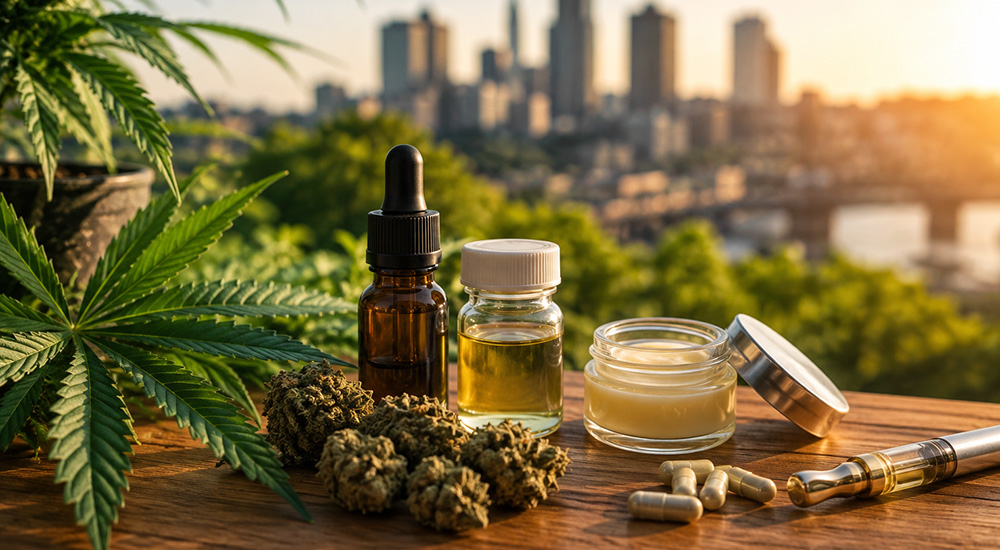
- The law initially authorized specific forms of medical marijuana, including pills, oils, tinctures, liquids, topicals and products administered through vaporization or nebulization. Dry leaf/flower was not initially permitted.
That last point changed fairly quickly. In May 2018, Pennsylvania approved dry leaf or plant material for administration by vaporization, and flower became available for purchase at dispensaries in August 2018. Smoking medical marijuana, however, remains prohibited.
In other words, 2016 was the legislative starting line but not yet a functioning marketplace.
2018: Patients Finally Get Access
The first dispensaries opened in February 2018, marking the point when Pennsylvania’s medical marijuana program moved from legislation and regulation into actual patient access.
The program was no longer just an idea on paper. Patients could finally obtain products through licensed dispensaries, and the state’s regulated market began generating sales.
2019 and Beyond: The Qualifying-Condition List Expands
Pennsylvania’s original 17-condition framework did not stay frozen. Today, the Pennsylvania Department of Health lists 24 qualifying serious medical conditions, including anxiety disorders, autism, opioid use disorder, Tourette syndrome and several neurological conditions and pain-related categories.
The state also recognizes two additional conditions: moderate to severe traumatic brain injury with chronic symptoms, and Type II diabetes mellitus. At this time, those conditions are approved only for Chapter 20 research purposes, meaning they are not simply additional qualifying conditions for the general patient program.
One of the most consequential additions was anxiety disorders. Research examining Pennsylvania’s certification data found that anxiety quickly became the most common qualifying diagnosis after it was added. In 2021, anxiety disorders were listed on approximately 60% of medical marijuana certifications created that year. A later study using more than 1.7 million Pennsylvania certification records through 2023 similarly found that adding anxiety fundamentally changed the makeup of the state’s program.
That doesn’t mean 60% of today’s active patients necessarily have anxiety as their qualifying condition. Rather, it illustrates just how dramatically the addition of a single condition changed participation in the program.
2021: Telehealth Changes Certification Access
Expanding who could qualify was only part of the story. Access to certifications themselves changed too, and another major turning point came with Act 44 of 2021.
The law authorized practitioners to issue medical marijuana certifications through synchronous interaction, meaning a real-time phone or video consultation.
Pennsylvania’s Department of Health continues to recognize this pathway today.
For patients, that represented a significant shift from the program’s early years. What began as a brand-new, largely in-person system evolved into one where certification could be completed remotely through telehealth.
2026: A $9 Billion-Plus Medical Marijuana Program
A decade after Act 16 was signed, Pennsylvania’s program looks dramatically different.
According to Medical Marijuana Program data presented to the state’s Medical Marijuana Advisory Board in 2026:
- 438,244 active patient certifications
- 1,109,727 total patient registrations since the program began
- 192 operational dispensaries
- 1,920 approved practitioners
- More than $9.1 billion in cumulative sales since the program launched
- Significant price compression across the market as competition and supply increased.
The price shift is particularly notable.
Retail dry-leaf prices fell from approximately $14.90 per gram in early 2021 to $7.60 per gram by early 2026. Wholesale prices fell from approximately $10.65 to $2.85 per gram over the same period.
That’s a very different market from the one Pennsylvania was building in 2016.
What Changed and What Didn’t
Pennsylvania went from a signed law with 17 serious medical conditions and no operating dispensaries to a regulated medical marijuana market with 24 qualifying conditions, nearly 200 dispensaries, more than 400,000 active patient certifications and more than $9 billion in cumulative sales.
But some of the program’s original boundaries remain.
Smoking medical marijuana is still prohibited. Dry leaf/flower may be purchased and used through vaporization, but Pennsylvania does not permit patients to smoke medical marijuana. Home cultivation remains prohibited under Pennsylvania’s medical marijuana program.
Pennsylvania has not legalized adult-use cannabis, although the issue continues to be debated in Harrisburg. As of 2026, all five of Pennsylvania’s other neighboring states, New York, New Jersey, Delaware, Maryland and Ohio, have adopted adult-use cannabis policies, while West Virginia remains the lone neighboring state without one.
The tax structure has also remained distinctive. Pennsylvania’s medical marijuana law requires growers/processors to pay a 5% tax on gross receipts from sales to dispensaries.
The Bottom Line
Pennsylvania’s medical marijuana program is almost unrecognizable compared with the one created in 2016, and the numbers above tell most of that story on their own.
Along the way, patients gained access to flower for vaporization, the qualifying-condition list expanded, anxiety became a major driver of certifications, and telehealth fundamentally changed how patients can obtain certifications. The next chapter may be even bigger.
Pennsylvania remains a medical-only state while all five of its other neighboring states now have adult-use cannabis policies. State leaders continue to debate whether and how to move Pennsylvania beyond its medical-only model.
Ten years after the signature that started it all, Pennsylvania’s medical marijuana program is no longer a new experiment. It’s a mature industry and whatever Pennsylvania decides to do next could reshape the cannabis market once again.
Contact Us Today
As Pennsylvania’s program continues to evolve, CCC is here to make getting and staying certified simple, convenient, and stress-free. Book now or call us at 412-730-3983.
Sources
- Pennsylvania Department of Health, Medical Marijuana Program data and Medical Marijuana Advisory Board program updates.
- Pennsylvania Department of Health, Medical Marijuana Official Two-Year Report.
- Pennsylvania Department of Health, Medical Marijuana Biennial Report 2024.
- Pennsylvania General Assembly, Medical Marijuana Act (Act 16 of 2016) and Act 44 of 2021.
- Pennsylvania Department of Health, Medical Marijuana Program practitioner and patient information.
- University of Pittsburgh / Johns Hopkins research on anxiety and Pennsylvania medical cannabis certifications.
- Spotlight PA analysis of Pennsylvania medical marijuana certification data.
- Pennsylvania Department of Revenue, Medical Marijuana Tax information.