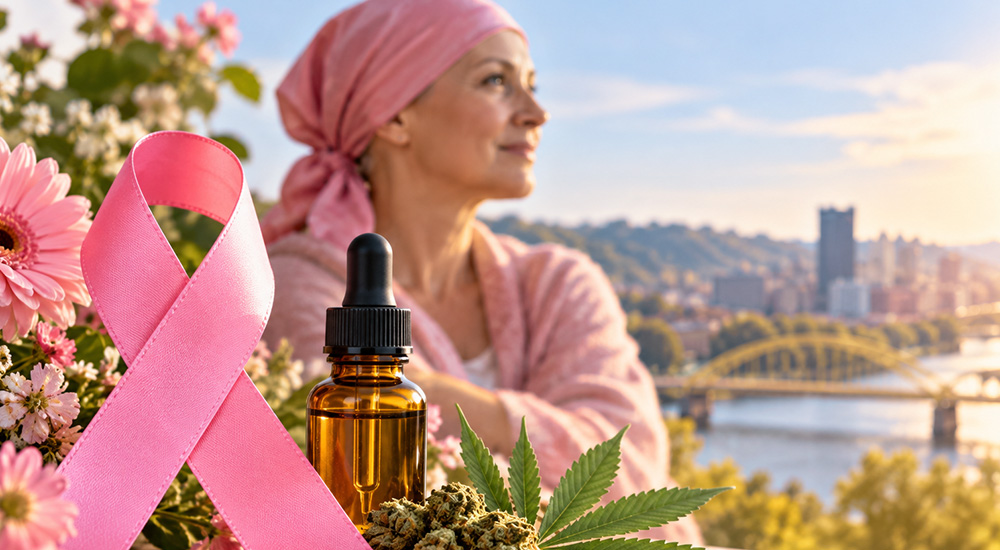

Every October, pink ribbons show up on storefronts, stadiums and social feeds for Breast Cancer Awareness Month. Behind those ribbons are real people: about 1 in 8 women in the United States will be diagnosed with breast cancer in her lifetime [3]. For many of them, the hardest part is not only the diagnosis. It is the months and sometimes years, of treatment side effects that follow.
If you or someone you love lives in Pennsylvania or West Virginia, here is something worth knowing this month: cancer, including breast cancer, is a qualifying condition for medical marijuana in both states [7][9]. In this blog, we cover the latest breast cancer numbers, what research says about breast cancer and medical marijuana, an important medication caution and the steps to get certified in each state.
Breast Cancer by the Numbers in 2026
The American Cancer Society (ACS) estimates that about 321,910 women in the U.S. will be diagnosed with invasive breast cancer in 2026, along with about 60,730 cases of ductal carcinoma in situ (DCIS), a noninvasive form of the disease [1]. Breast cancer accounts for roughly 1 in 3 new cancers in women each year [1]. Men are affected too with about 2,670 cases expected this year [3].
Closer to home, ACS projects about 13,720 new invasive breast cancer cases in Pennsylvania and 1,680 in West Virginia in 2026 [2]. That is thousands of neighbors, coworkers, and family members across our region beginning treatment this year.
There is real reason for hope as well. More than 4 million breast cancer survivors live in the U.S. today, and when breast cancer is found at an early, localized stage, the 5-year relative survival rate is over 99% [3].
Early Detection Still Comes First
Before we talk about possible symptom relief, the core message of Breast Cancer Awareness Month bears repeating screening saves lives. Women ages 50 to 74 who get a mammogram every two years have a 26% lower risk of dying from breast cancer than women who are not screened [3]. About two-thirds of breast cancers are diagnosed at a localized stage, when they are easier to treat [3].
If you are due for a mammogram, use this month as your reminder to book it. Medical marijuana is not a screening tool, a prevention strategy, or a cure. It is a possible way to manage certain symptoms alongside the care your oncology team provides.
How Medical Marijuana May Help Manage Breast Cancer Treatment Symptoms
Breast cancer treatment often combines surgery, chemotherapy, radiation and years of hormone (endocrine) therapy such as tamoxifen or aromatase inhibitors. Each can bring side effects that affect daily life, including:
- Nausea and vomiting during chemotherapy
- Pain, including nerve pain (neuropathy) from certain chemotherapy drugs
- Trouble sleeping and fatigue
- Loss of appetite
- Anxiety and stress
- Hot flashes and joint aches during endocrine therapy
It is no surprise that many patients are curious. ASCO, the American Society of Clinical Oncology reports that roughly 20% to more than 40% of adults with cancer use medical cannabis products [10]. Among U.S. breast cancer patients specifically, more than 20% have used cannabinoids during endocrine therapy hoping to ease side effects [6].
What the Research Says, and What It Does Not
Where the evidence is strongest
In 2017, the National Academies of Sciences, Engineering, and Medicine completed a major review of cannabis research. The committee found conclusive evidence that orally administered THC is effective for chemotherapy-induced nausea and vomiting, and substantial evidence that some cannabis products help treat chronic pain in adults [4]. It also found moderate evidence that certain cannabinoid products can improve short-term sleep for people whose sleep is disrupted by chronic pain and some other conditions [4].
In 2024, ASCO published its first guideline on cannabis and cannabinoids in adults with cancer. It concluded that cannabis or cannabinoids may aide with chemotherapy-induced nausea and vomiting that does not respond to standard anti-nausea medicine, when added to a standard regimen [5].
Where the evidence is still limited
ASCO was also direct that access to medical cannabis has outpaced the science [5]. For most other supportive care goals in people with cancer such as pain, appetite and sleep, whether cannabis helps remains uncertain and more research is needed [5][10]. Most importantly, ASCO recommends against using cannabis to treat the cancer itself outside of a clinical trial [5]. Medical marijuana should never replace surgery, chemotherapy, radiation or hormone therapy.
The takeaway: medical marijuana may be a reasonable option to discuss for specific symptoms, especially stubborn nausea and it works best as part of a plan your care team knows about.
Medical Marijuana and Breast Cancer Treatment Symptoms
| Symptom or Concern | What Research Suggests |
|---|---|
| Chemotherapy-Related Nausea and Vomiting | Certain cannabinoid medicines may help when standard anti-nausea treatments are not effective enough. |
| Chronic Pain | Some cannabis products may help with certain types of chronic pain, but benefits vary. |
| Sleep Difficulties | Some evidence suggests potential benefits in specific conditions, but findings are limited. |
| Appetite and Other Side Effects | Evidence remains uncertain for many cancer-related symptoms. |
| Treating Breast Cancer Itself | Medical marijuana is not an established cure or replacement for standard cancer treatment. |
A Note on Tamoxifen and Drug Interactions
This point matters for breast cancer patients in particular. The body converts tamoxifen into its more active form, endoxifen, partly through a liver enzyme called CYP2D6. CBD can inhibit that enzyme, which raises the question of whether it could make tamoxifen less effective [6].
A 2023 study in npj Breast Cancer followed women on tamoxifen who added CBD oil for four weeks. On average, endoxifen levels fell by about 12.6% but stayed within accepted equivalence limits and patients reported meaningful improvements in endocrine side effects and quality of life [6]. However, patients with slower CYP2D6 metabolism saw a significant drop in tamoxifen and endoxifen levels and the researchers limited their conclusion to good-quality CBD oil at doses under 50 mg [6].
Bottom line: if you take tamoxifen, an aromatase inhibitor or any other cancer medication, talk with your oncologist or pharmacist before starting any cannabis or CBD products and share your full medication list with your certifying practitioner.
Breast Cancer Is a Qualifying Condition in Pennsylvania
Pennsylvania’s Medical Marijuana Program lists “cancer, including remission therapy” as a serious medical condition [7]. That remission language matters for survivors. Patients who have finished active treatment may still qualify, which is relevant for the many breast cancer survivors who stay on hormone therapy for five years or longer.
How to get a medical marijuana card in Pennsylvania
The Pennsylvania Department of Health outlines four steps [7]:
- Register online in the Medical Marijuana Program registry. You will need a Pennsylvania driver’s license or state ID and a working email address.
- Get certified by a Department of Health approved practitioner. A certification can last up to one year and the visit is not covered by insurance.
- Pay for your ID card. The fee is $50 and people enrolled in Medicaid, PACE/PACENET, CHIP, SNAP or WIC may qualify for a no-cost card. Payment must be made within 60 days of certification.
- Visit any Pennsylvania dispensary with your ID card. Allow about 7 days for printing and 14 days for mail delivery.
Patients who are homebound can designate up to two caregivers to pick up medicine on their behalf [7].
Breast Cancer Is a Qualifying Condition in West Virginia
West Virginia’s Medical Cannabis Act lists cancer as a qualifying serious medical condition [9]. Unlike Pennsylvania, West Virginia’s list does not specifically mention remission therapy, so survivors who have completed treatment should ask a registered physician whether they qualify.
How to get a medical cannabis card in West Virginia
The West Virginia Office of Medical Cannabis outlines this process [8][9]:
- Confirm your condition on the Office of Medical Cannabis list of qualifying conditions.
- Get certified by a Department of Health approved practitioner. A certification can last up to one year and the visit is not covered by insurance.
- Apply through the state registration portal with your certification and proof of West Virginia residency.
- Pay the $50 state fee, unless you qualify for a financial hardship waiver.
- Watch your email. Applications are typically reviewed within 30 days, and approved patients download a digital card to show at licensed dispensaries.
A patient may designate up to two caregivers so that access to medical cannabis is easier
Questions to Bring to Your Care Team
ASCO encourages clinicians to have open, nonjudgmental conversations with patients about medical cannabis [5], so you should feel comfortable raising the topic. A few questions to start with:
- Which of my symptoms might medical marijuana reasonably help and which should we manage another way?
- Could cannabis or CBD interact with my current cancer medications?
- Are there product types or forms I should avoid during treatment?
- How will we track whether it is actually helping?
The Bottom Line
Breast Cancer Awareness Month is a reminder to get screened, support the people in your life who are in treatment, and learn about every tool that can make the road easier. For patients in Pennsylvania and West Virginia, medical marijuana is a legal option for managing certain breast cancer symptoms when it is used safely and alongside standard care.
Have questions about getting certified? Call today us today at 412-730-3983 or book an appointment!
Disclaimer: This article is for educational purposes only and is not medical or legal advice. Medical marijuana is not a treatment for cancer. Always talk with your oncologist before starting any new therapy. Program rules and fees can change, so check the Pennsylvania Department of Health and West Virginia Office of Medical Cannabis websites for current requirements.
Frequently Asked Questions (FAQs)
Below are some commonly asked questions to consider:
1. Does breast cancer qualify for medical marijuana in Pennsylvania?
Yes. Cancer is listed as a qualifying serious medical condition under Pennsylvania’s Medical Marijuana Program. Patients with breast cancer must also meet the state’s eligibility requirements and obtain certification from an approved practitioner.
2. Am I eligible for medical cannabis in West Virginia if I have breast cancer?
Yes. Cancer is a qualifying condition under West Virginia’s Medical Cannabis Program. Patients diagnosed with breast cancer may qualify if they meet the state’s eligibility requirements and receive certification from a registered physician.
3. Can medical marijuana help manage breast cancer symptoms?
Certain cannabis-derived products may help relieve some cancer-related symptoms, such as nausea and pain, in certain patients. However, medical marijuana is not a cure for breast cancer and should never replace prescribed cancer treatments.
4. Is CBD safe for breast cancer patients taking tamoxifen?
CBD may affect enzymes involved in how the body metabolizes tamoxifen, potentially influencing medication levels. Patients taking tamoxifen should consult their oncologist or pharmacist before using CBD or other cannabis products.
5. Can breast cancer patients use medical marijuana during chemotherapy?
Some breast cancer patients may consider medical marijuana to help manage chemotherapy-related symptoms, such as nausea and pain. However, cannabis products may interact with cancer medications. Patients should consult their oncology team before using any cannabis-based products.
Sources
- American Cancer Society. Key Statistics for Breast Cancer. Updated June 2026. https://www.cancer.org/cancer/types/breast-cancer/key-statistics.html
- American Cancer Society. Estimated Number of New Cases for Selected Cancers by State, US, 2026. https://www.cancer.org/content/dam/cancer-org/research/cancer-facts-and-statistics/annual-cancer-facts-and-figures/2026/mr4-cases-by-state-2026-branded.pdf
- National Breast Cancer Foundation. 2026 Breast Cancer Statistics (citing American Cancer Society and CDC). https://www.nationalbreastcancer.org/wp-content/uploads/2026/07/2026-Breast-Cancer-Statistics-One-Pager.pdf
- National Academies of Sciences, Engineering, and Medicine. The Health Effects of Cannabis and Cannabinoids (2017), congressional testimony summary. https://www.nationalacademies.org/units/NRCEO-NRC%20EO-23-P-592/congressional-briefing-and-testimony/the-health-effects-of-cannabis-and-cannabinoids
- Braun IM, et al. Cannabis and Cannabinoids in Adults With Cancer: ASCO Guideline. Journal of Clinical Oncology. 2024;42(13):1575-1593. https://pmc.ncbi.nlm.nih.gov/articles/11730458/
- Buijs SM, et al. CBD-oil as a potential solution in case of severe tamoxifen-related side effects. npj Breast Cancer. 2023. https://pmc.ncbi.nlm.nih.gov/articles/PMC10404290
- Pennsylvania Department of Health. Medical Marijuana Program: Patients and Caregivers. https://www.pa.gov/agencies/health/programs/medical-marijuana/medical-marijuana-patients
- West Virginia Office of Medical Cannabis. Patient Application. https://omc.wv.gov/patient-application
- West Virginia Office of Medical Cannabis. Patient Registration Process. https://omc.wv.gov/patients/Documents/PATIENT%20REGISTRATION%20PROCESS.pdf
ASCO. Cannabis and Cannabinoids: Patient Guide (via Guideline Central). 2024. https://www.guidelinecentral.com/guideline/3498831/patient-education/3531613/