
QUALIFYING CONDITIONS
Epilepsy & Medical Marijuana: Pennsylvania & West Virginia Qualifying Condition Guide
Compassionate Certification Centers serves epilepsy patients across Pennsylvania and West Virginia with compassionate, judgment-free evaluations. Our certified physicians are here to help you understand your options and coordinate safely with your existing neurological care.
ABOUT Epilepsy
Epilepsy is a neurological disorder of the central nervous system characterized by recurrent, unprovoked seizures. It is one of the most common neurological disorders worldwide, and Pennsylvania and West Virginia both recognize epilepsy as a qualifying condition for medical marijuana. If you or a loved one has been diagnosed with epilepsy, Compassionate Certification Centers can help you understand your options and determine whether certification may be appropriate as part of your neurological care.
Epilepsy and cannabis are one of the few areas in this field with genuine FDA-approved pharmaceutical precedent but the evidence is also more specific and more nuanced than it is often portrayed. A purified CBD medication is FDA-approved for three specific, severe epilepsy syndromes. At the same time, products containing THC can trigger or worsen seizures in some patients. This page presents both sides of that picture clearly, because the distinction matters significantly for patient safety.
What Is Epilepsy?
Epilepsy occurs when abnormal electrical activity in the brain leads to recurrent seizures. The character of a seizure depends on which brain regions are affected and how the abnormal activity spreads, some patients experience brief lapses in awareness (absence seizures), while others experience convulsive, full-body episodes (tonic-clonic seizures). Seizure intensity, frequency, and presentation vary considerably from person to person.
Causes of Epilepsy
In roughly half of epilepsy cases, no specific underlying cause can be identified. Where a cause is identified, contributing factors may include:
- Genetic factors — family history of seizures increases risk
- Head trauma or traumatic brain injury
- Stroke or other cerebrovascular conditions
- Brain tumors or structural brain abnormalities
- Prenatal injury or developmental brain abnormalities
- Infectious conditions affecting the brain (e.g., meningitis, encephalitis)
- Developmental disorders, including some genetic syndromes associated with epilepsy
How Is Epilepsy Diagnosed?
Diagnosis begins with a detailed review of medical history and seizure description, followed by diagnostic testing that may include:
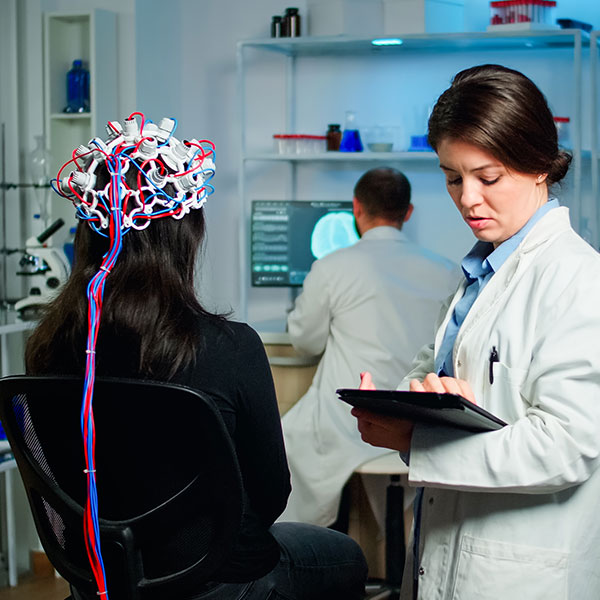
- Electroencephalogram (EEG): Records electrical activity in the brain and is the primary diagnostic tool for epilepsy.
- MRI: Identifies structural brain abnormalities that may be causing seizures.
- CT Scan: May be used, particularly in acute settings, to rule out structural causes.
- Blood Tests: Help rule out metabolic or infectious causes of seizures.
- Neurological Examination: Assesses motor function, reflexes, and cognitive status.
- Genetic Testing: Increasingly used to identify specific epilepsy syndromes, particularly in pediatric and treatment-resistant cases.
Epilepsy Statistics & Prevalence
- According to the World Health Organization, approximately 50 million people worldwide live with epilepsy, making it one of the most common neurological disorders globally.
- Approximately 1% of Americans live with epilepsy.
- Up to 70% of people with epilepsy can become seizure-free with appropriate, individualized treatment.
- Despite available antiepileptic drugs (AEDs), an estimated 30% of patients have epilepsy that does not respond adequately to medication, known as drug-resistant or refractory epilepsy.
- Refractory epilepsy is the population in which most cannabis-related epilepsy research, including the pivotal Epidiolex trials, has been conducted.
Epilepsy-Related Diagnoses That Qualify in Pennsylvania & West Virginia
Pennsylvania and West Virginia recognize a broad range of epilepsy diagnoses and seizure-related syndromes as qualifying conditions, including:
- Intractable Epilepsy / Pharmacoresistant Epilepsy
- Lennox-Gastaut Syndrome
- Childhood Epilepsy / Benign Childhood Epilepsy with Centrotemporal EEG Spikes
- Juvenile Absence Epilepsy / Juvenile Myoclonic Epilepsy
- Myoclonic Epilepsy / Progressive Myoclonic Epilepsy / Benign Myoclonic in Infancy
- Epilepsy with Complex Partial Seizures / Simple Partial Seizures
- Epilepsy with Grand Mal Seizures on Awakening
- Tonic Epilepsy
- Epileptic Syndromes (general)
- Visual, Somatomotor, and Somatosensory Epilepsy
- Spasms (infantile spasms and related syndromes)
- Unverricht Epilepsy
- Other rare and named epilepsy syndromes (e.g., Kozhevnikof’s Epilepsy, Bravais-Jacksonian Epilepsy)
This is a broad qualifying category. If you’re unsure whether your specific epilepsy diagnosis qualifies, our team can review your medical records and help determine eligibility.
Common Symptoms of Epilepsy
Seizure presentation varies widely depending on seizure type and the brain regions involved. Common symptoms include:
- Staring blankly for several seconds or minutes (absence seizures)
- Temporary confusion following a seizure (postictal state)
- Uncontrollable jerking movements of the arms or legs
- Stiffening of the body (tonic seizures)
- Loss of consciousness
- Loss of awareness of surroundings
- Repetitive movements (automatisms)
- Sensory alterations — changes in smell, taste, hearing, touch, or vision (auras)
- Anxiety or fear preceding a seizure
- Fatigue following a seizure
Medical Cannabis & Epilepsy: What the Research Currently Shows
Epilepsy is the condition with the clearest FDA precedent for a cannabis-derived medication anywhere in this field — but it’s important to understand precisely what is and is not approved, and for whom. The evidence strongly distinguishes between purified, pharmaceutical-grade CBD and broader cannabis or THC-containing products, which carry a documented risk of worsening seizures in some patients. This section presents that full picture. It is informational only and does not constitute medical advice.
1. Epidiolex (CBD): FDA-Approved for Three Specific Syndromes
In June 2018, the FDA approved Epidiolex, a plant-derived, pharmaceutical-grade CBD oral solution, for the treatment of seizures associated with Lennox-Gastaut syndrome and Dravet syndrome in patients 2 years and older — the first FDA approval of any marijuana-derived medication. The approval was based on three randomized, double-blind, placebo-controlled trials involving 516 patients, which found a 50% reduction in drop-seizure frequency in 40–44% of Lennox-Gastaut patients and a 39% reduction in convulsive seizure frequency in Dravet syndrome patients, compared to placebo. Epidiolex was later also approved for seizures associated with tuberous sclerosis complex in patients 1 year and older.
This approval is specific and important to understand precisely: it applies to a particular pharmaceutical formulation of purified CBD, for three particular epilepsy syndromes, based on rigorous controlled trials. The FDA itself has been explicit that this is not an approval of marijuana broadly or of any other cannabis-derived product.
2. CBD’s Efficacy in Other Epilepsy Syndromes: Far Less Established
Outside of Lennox-Gastaut syndrome, Dravet syndrome, and tuberous sclerosis complex, evidence for CBD’s effectiveness in other epilepsy types is considerably more limited. Clinical epilepsy resources note there is very limited evidence of CBD’s efficacy in other epilepsy syndromes, and explicitly caution that there is no current evidence that CBD or broader medical marijuana use is beneficial for patients whose epilepsy is already well-controlled with standard medication. Patients with epilepsy types outside the three FDA-approved syndromes should not assume the Epidiolex trial results apply directly to their situation.
3. An Important Safety Distinction: THC Can Trigger or Worsen Seizures
This is a critical safety point that is often overlooked. While purified CBD has anticonvulsant properties in specific syndromes, THC — the primary psychoactive component of cannabis — can have the opposite effect in some circumstances. THC may alter neuronal excitability and has been associated with new-onset seizures, breakthrough seizures in patients with previously controlled epilepsy, and worsened seizure control, particularly with high-potency or synthetic cannabinoid products. A 2022 scoping review found that 10 of 11 studies examining acute cannabis exposure reported a higher-than-expected incidence of seizures relative to general population rates. Case reports have also documented patients with focal epilepsy experiencing breakthrough seizures temporally associated with cannabis use, including possible interference with other prescribed seizure treatments.
4. Cannabis Should Never Replace Prescribed Antiseizure Medication
Clinical epilepsy guidance is explicit on this point: there is no current evidence that patients using CBD or medical marijuana can safely stop or reduce their prescribed antiseizure medications, and the limited available evidence actually points against doing so without close medical supervision. Any cannabis use for epilepsy — whether CBD-focused or otherwise — should be considered as a potential adjunct to, not a replacement for, prescribed antiseizure medication, and should always be discussed with a treating neurologist or epileptologist.
5. Drug Interactions: An Important Practical Consideration
CBD, including Epidiolex, has documented drug-drug interactions with several common antiseizure medications, including clobazam and valproate, which can affect blood levels of these medications and increase the risk of side effects such as liver enzyme elevations. Patients considering any cannabis-based product for epilepsy should have these interactions reviewed carefully by their prescribing neurologist, with appropriate monitoring.
Medical Disclaimer: Only one specific pharmaceutical CBD product (Epidiolex) is FDA-approved, and only for seizures associated with Lennox-Gastaut syndrome, Dravet syndrome, and tuberous sclerosis complex. This approval does not extend to other cannabis or CBD products, or to other epilepsy types. THC-containing cannabis products carry a documented risk of triggering or worsening seizures in some patients and should be approached with particular caution. The information in this section is provided for general informational purposes only and does not constitute medical advice. Patients should never stop, reduce, or replace prescribed antiseizure medication with cannabis without close supervision from their neurologist. Always consult your neurologist or epileptologist, along with a certified medical marijuana physician, before incorporating any cannabis product into your epilepsy care.
APPLICATION GUIDE
How to Get a Medical Marijuana Card for Epilepsy in Pennsylvania or West Virginia
Both Pennsylvania and West Virginia recognize epilepsy as a qualifying condition. The certification process with Compassionate Certification Centers is straightforward:
Step 1: Register over the phone or online, next-day appointments are often available.
Step 2: Meet with a certified medical marijuana physician who will review your epilepsy diagnosis, current antiseizure medications, and seizure history to determine whether certification is appropriate.
Step 3: Receive your medical marijuana card and begin purchasing from licensed dispensaries in Pennsylvania or West Virginia.
Our physicians are experienced in working alongside neurologists and epileptologists and can help ensure that any cannabis-based approach is carefully considered in the context of your existing antiseizure treatment, including a thorough review of potential drug interactions.
SOURCES & REFERENCES
The following peer-reviewed publications, FDA records, and clinical resources informed the research summary above. All sources are publicly accessible. No source should be interpreted as establishing broad medical marijuana as an FDA-approved or universally safe treatment for epilepsy.
FDA Approval & Pivotal Trials — Epidiolex
[1] U.S. Food and Drug Administration. (2018). “FDA approves first drug comprised of an active ingredient derived from marijuana to treat rare, severe forms of epilepsy.” FDA News Release, June 25, 2018.
The FDA’s official announcement of Epidiolex approval for Lennox-Gastaut and Dravet syndromes — the first-ever FDA approval of a marijuana-derived pharmaceutical. The approval was explicitly limited to this specific CBD formulation for these specific syndromes, not to marijuana or its components broadly.
[2] Devinsky O, et al. (2017). “Trial of Cannabidiol for Drug-Resistant Seizures in the Dravet Syndrome.” New England Journal of Medicine, 376(21), 2011–2020.
One of the pivotal randomized, placebo-controlled trials supporting Epidiolex approval, finding a 39% reduction in convulsive seizure frequency in Dravet syndrome patients receiving CBD versus placebo.
[3] Wechsler RT, et al. (2024). “Consensus panel recommendations for the optimization of EPIDIOLEX® treatment for seizures associated with Lennox–Gastaut syndrome, Dravet syndrome, and tuberous sclerosis complex.” Epilepsia Open, 9, 1632–1642. PMC ID: PMC11450617.
https://pmc.ncbi.nlm.nih.gov/articles/PMC11450617/
A 2024 expert consensus panel confirming Epidiolex’s current FDA-approved indications (LGS, Dravet, tuberous sclerosis complex) and providing guidance on dosing, drug interactions, and safety monitoring — the most current authoritative clinical source on appropriate Epidiolex use.
Limited Evidence Outside Approved Syndromes
[4] University of Minnesota Health / MN Epilepsy Group. “Epilepsy and Cannabis.” Clinical patient resource.
https://mnepilepsy.org/patient-information/seizure-medicines/epilepsy-and-cannabis/
A clinical epilepsy program resource explicitly noting very limited evidence of CBD’s efficacy outside FDA-approved syndromes, and stating there is no current evidence supporting CBD or medical marijuana use in patients whose epilepsy is already well-controlled, or that patients can safely discontinue antiseizure medications while using cannabis.
THC, Cannabis & Seizure Risk — Safety Evidence
[5] (2022). “The Potential Proconvulsant Effects of Cannabis: A Scoping Review.” PMC ID: PMC9198115.
https://pmc.ncbi.nlm.nih.gov/articles/PMC9198115/
A scoping review finding that 10 of 11 studies examining acute cannabis exposure reported higher-than-expected seizure incidence relative to general and pediatric population rates. An important counterbalance to the CBD-specific findings, demonstrating that not all cannabis products are seizure-protective.
[6] (2025). “The role of cannabis in epilepsy illustrated by two case reports.” PMC ID: PMC12274293.
https://pmc.ncbi.nlm.nih.gov/articles/PMC12274293/
Two case reports of patients with focal epilepsy experiencing breakthrough seizures temporally associated with chronic cannabis use, including possible interference with prescribed antiseizure medications and neuromodulation therapy. Authors caution these retrospective findings should be interpreted carefully but highlight a real clinical concern.